
Chuck Schumer leadership challenge: Van Hollen contests Senate role
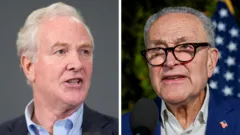
The Chuck Schumer leadership challenge emerged as Senator Chris Van Hollen announced his intention to contest the position of Democratic Senate majority leader. Following the party's sweeping midterm election victories, Van Hollen, 67, argued that the Democratic caucus requires new leadership to deliver on the mandate provided by voters. The contest follows a period of internal pressure from left-wing Democrats regarding Schumer's moderate stance. A decisive vote on the new Senate leader is scheduled to take place behind closed doors in early December 2026.
The core contest for Democratic Senate leadership
Senator Chris Van Hollen has officially launched a bid to replace Chuck Schumer as the Democratic leader in the Senate. This challenge arrives as the Democratic Party prepares to assume control of both the Senate and the House of Representatives on 4 January, following their successes in the midterms held earlier this month. Van Hollen, representing Maryland, framed his candidacy as a necessary response to the electorate's desire for systemic change.
In a post on X on Thursday, Van Hollen stated that Americans voted for change earlier this month and concluded that "to deliver, we need new leadership." He further emphasized the need for a government focused on the citizenry rather than special interests, telling a summit in Colorado hosted by majority Democrats, "We should not be preserving our institutions if they are not delivering for the American people."
The upcoming leadership transition is structured around a specific timeline. The internal party vote will be conducted behind closed doors in early December. The winner of this contest will officially assume the role of Senate leader when the new Congress convenes in January.
The political landscape of the 2026 midterms
The leadership struggle is a direct consequence of the Democratic Party's performance in the recent midterm elections. While the party achieved significant gains, the results have intensified internal debates regarding the party's ideological direction. Some left-wing members of the caucus have expressed dissatisfaction with the current establishment, viewing Schumer as being too moderate to address the core grievances of the working class.
Schumer's response and tenure in the Senate
Chuck Schumer, 75, has defended his position, asserting that he possesses the necessary support to maintain his role. Representing New York, Schumer has been a central figure in Senate leadership since 2017, having served as both the majority and minority leader during his tenure. His career in the Senate dates back to 1999, providing him with a long history of institutional experience.
Responding to the challenge from Van Hollen, Schumer stated that he welcomed "any discussion about the future of our caucus and the important work ahead." However, he also maintained his confidence in his standing within the party, noting that he was "proud of what we've accomplished together" during the midterm campaign and explicitly stating that he "had the votes to continue as Democratic leader."
The tension between the established leadership and the challengers highlights a division in how the party intends to utilize its new majority. While Schumer emphasizes stability and his proven track record, the challenger focuses on a perceived need to disrupt existing structures to better serve the public interest.
Van Hollen's ideological platform and endorsements
Chris Van Hollen's campaign is built on a platform of economic reform and progressive policy shifts. He has positioned himself as a candidate who will prioritize "unrigging an economy rigged against working people," according to his announcements on X. His legislative record has frequently aligned with the more progressive wings of the Democratic Party.
In recent years, Van Hollen has adopted several stances that have resonated with the party's left flank. For instance, in 2024, he supported measures to restrict weapons shipments to Israel and was a vocal critic of the Biden administration regarding its handling of the war in Gaza. This history provides the foundation for his current attempt to shift the party's leadership focus.
Support and opposition within the Democratic caucus
The leadership race has divided prominent members of the Democratic Party, creating a clear spectrum of support. Van Hollen has secured high-profile backing from figures on the left, while other senators have rallied around the incumbent.
The following table outlines the primary voices involved in the leadership debate:
| Senator | Affiliation | Position on Leadership | Key Statement/Reasoning |
|---|---|---|---|
| Chris Van Hollen | Democrat (MD) | Challenger | Argues for new leadership to deliver change and unrig the economy. |
| Chuck Schumer | Democrat (NY) | Incumbent | Claims to have the votes to continue and welcomes discussion. |
| Bernie Sanders | Independent | Supports Van Hollen | States Van Hollen will fight the billionaire class and special interests. |
| Abdul El-Sayed | Democrat-elect | Supports Van Hollen | Claims Van Hollen will bring "bold leadership" and courage. |
| Jacky Rosen | Democrat (NV) | Supports Schumer | Cites his experience and ability to lead a diverse caucus. |
| Kirsten Gillibrand | Democrat (NY) | Supports Schumer | Expresses gratitude for his hard work in achieving midterm success. |
The strategic implications of the December vote
The outcome of the December vote will determine the Democratic Party's approach to governing during the upcoming term. Because the Democrats are set to control both chambers of Congress, the Senate leader will hold significant influence over the legislative agenda and the party's ability to implement its midterm promises.
Van Hollen has acknowledged the difficulty of his position, describing himself as an "underdog" in an interview with MS NOW. Despite this, he has maintained that the race is "very much in flux," suggesting that the internal deliberations among the Democratic senators remain undecided. The contest is not merely about personal leadership but about whether the party will pursue a more confrontational approach toward special interests or maintain the institutional continuity offered by Schumer.
If Van Hollen succeeds, it would mark the most significant challenge by a high-profile Democrat to the existing leadership following a major electoral victory. If Schumer retains his post, the party will likely continue under the established leadership structure that guided them through the 2026 midterm cycle.
