
Gibran Rakabuming Raka resignation sparks political crisis
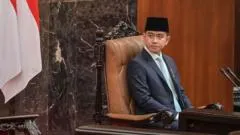
Gibran Rakabuming Raka resigned as Indonesia's Vice President on Thursday, following a Supreme Court ruling that invalidated his high-school credentials used during the 2024 election. The Gibran Rakabuming Raka resignation follows intense impeachment pressure from over 100 lawmakers. President Prabowo Subianto accepted the departure with a "heavy heart," noting the move was for the benefit of the nation. The vacancy must now be filled within 60 days by two candidates nominated by the president and approved by the upper house.
The legal catalyst behind the Vice President's departure
The resignation was precipitated by a Supreme Court ruling that found no evidence Gibran Rakabuming Raka possessed the necessary educational qualifications required by Indonesian law to hold office. While Gibran had previously argued that his university education served as sufficient proof of completing secondary school, the court maintained that specific documentation was required to bridge his international studies in Singapore and Australia with Indonesian standards.
According to the Supreme Court, "No evidence was found to show Gibran had a foreign diploma or certificate that could serve as the basis for equivalency with a senior high school or equivalent qualification." This decision aligned with a prior Constitutional Court ruling from October that reached an identical conclusion regarding his credentials. The legal uncertainty had already created significant political momentum, with more than 100 lawmakers supporting a parliamentary initiative to initiate impeachment proceedings against him.
Educational equivalency disputes
The core of the controversy rested on an Indonesian equivalence certificate Gibran used to demonstrate his senior secondary education. Because he studied abroad, the legal requirement for a formal equivalency was central to his eligibility. Although State Secretariat Prasetyo Hadi noted that Gibran had requested an opportunity to challenge the ruling and prove the legitimacy of his credentials on Tuesday, the Supreme Court's findings effectively closed the legal avenue for his continued tenure.
Shifting dynamics within the Prabowo-Jokowi alliance
Gibran’s exit highlights a growing fracture in the political coalition formed between President Prabowo Subianto and outgoing President Joko Widodo, also known as Jokowi. The alliance, which secured Gibran’s place on the 2024 ticket, was built on a strategic partnership between the two leaders, despite their history as bitter rivals. However, recent policy shifts and personnel changes suggest the partnership is no longer cohesive.
Since assuming the presidency, Prabowo has pivoted away from several of Jokowi's signature legacies. Most notably, the administration has shown little interest in continuing the construction of Nusantara, the new capital city project championed by Jokowi. Instead, Prabowo has prioritized his own flagship initiative: a national program to provide free school meals. This divergence in policy priorities is accompanied by significant changes in the government's personnel structure.
| Policy/Personnel Area | Jokowi Legacy/Affiliation | Prabowo Current Direction |
|---|---|---|
| Infrastructure | Nusantara New Capital Construction | Limited interest/focus |
| Social Programs | General development | Free school meals program |
| Cabinet Alignment | High concentration of Jokowi loyalists | Reshuffling of loyalists to new roles |
The redistribution of power is evident in the recent treatment of long-serving officials. Prabowo has moved many of Jokowi's loyalists into different roles, including the finance minister, Sri Mulyani Indrawati. These shifts indicate a move toward a more centralized administration under Prabowo's specific vision, rather than a continuation of the previous administration's collaborative approach.
Internal instability and recent high-level arrests
The political tension has escalated beyond policy disagreements into direct confrontations involving high-ranking state officials. The stability of the administration was recently shaken by the arrest of several senior officials, including the presidential chief of staff, Listyo Sigit Prabowo. Although he is no relation to the President, Listyo was widely viewed as a long-time ally of Jokowi.
The arrest was linked to suspicions of wiretapping the president. Following the incident, Prabowo dismissed Listyo from his position, a move that many political analysts interpret as a sign of the crumbling alliance between the current presidency and the Jokowi faction. This instability is further reflected in the movement of cabinet members. On Monday, three members of Prabowo's cabinet resigned from the political party led by Kaesang Pangarep, the youngest son of Jokowi, stating they wished to focus solely on their administrative duties.
The role of Kaesang Pangarep's party
The resignation of these cabinet members from Kaesang Pangarep's party serves as a physical manifestation of the political decoupling. While neither Prabowo nor Jokowi has officially confirmed a formal rift, the departure of officials from the Jokowi family's political vehicle suggests that the formal structures of the 2024 coalition are being dismantled in favor of new, individual political alignments.
National challenges facing the Prabowo administration
The leadership transition occurs at a time of significant domestic pressure, as the government grapples with economic, environmental, and social crises. The administration's ability to manage the vice-presidential vacancy will be tested against a backdrop of widespread public dissatisfaction and systemic instability.
The government is currently facing several critical issues:
- Economic Volatility: The national stock market is experiencing a crisis following allegations of widespread market manipulation.
- Funding Shortfalls: The flagship free school meals programme is currently struggling to secure adequate funding.
- Environmental Crisis: Parts of the country are dealing with the worst wildfires seen in a decade.
- Social Unrest: Students and activists have organized demonstrations to protest government corruption and the handling of the environmental crisis.
As the upper house prepares to select a new vice president, the administration must navigate these overlapping crises while attempting to stabilize the political landscape. The 60-day window for the appointment provides a critical period for Prabowo to consolidate his leadership and address the concerns of a restless electorate.
