
Bangladesh clothing factory strikes: Workers seek higher pay
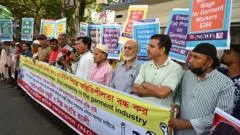
Bangladesh clothing factory strikes have led to the closure of nearly 150 textile sites across the Savar, Ashulia, and Gazipur hubs. Workers are protesting for a minimum monthly wage of 30,000 taka (£182), a significant increase from the current 12,500 taka. The garment industry accounts for 10% of Bangladesh's GDP and generates approximately $40bn in annual exports. As protests disrupt major transport routes, the industry faces potential delays for global retailers including H&M, Primark, and Zara. Local labor unions argue that current inflation has made the existing wage unsustainable for families.
Widespread closures in textile hubs Savar, Ashulia, and Gazipur
Nearly 150 garment manufacturing sites have been forced to shut down across Bangladesh's primary textile production regions following widespread labor unrest. The closures are concentrated in the industrial hubs of Savar, Ashulia, and Gazipur, where workers have staged protests to demand a revised pay structure. On Sunday morning, demonstrators blocked the Dhaka-Tangail highway in Gazipur, causing traffic to come to a standstill for approximately one hour before police intervention.
Local authorities have confirmed the scale of the disruption. Police Supt Mohammad Amjad Hossain told the BBC that 13 factories were closed on Saturday night, followed by an additional 16 factory closures during the morning unrest on Sunday. The sudden cessation of operations highlights the volatility currently facing the nation's most critical manufacturing sector.
Impact on regional transport and local security
The protests have moved beyond factory gates to affect critical infrastructure. By massing on major transit arteries like the Dhaka-Tangail highway, workers have demonstrated the ability to disrupt the logistics necessary for moving goods and personnel. While police have stepped in to manage the crowds, the recurring nature of these demonstrations suggests a sustained period of instability in the industrial zones.
The economic scale of the Bangladesh garment industry
The garment industry serves as a cornerstone of the Bangladeshi economy, contributing 10% to the country's total Gross Domestic Product (GDP). The sector generates nearly $40bn (£30bn) in export revenue annually, making Bangladesh the world's second-largest exporter of ready-to-wear clothing, trailing only China. This economic weight means that prolonged industrial action carries significant implications for both national stability and international trade.
The workforce supporting this massive export engine consists of approximately four million employees. These workers produce apparel for some of the world's largest retail brands, including Zara, Primark, and H&M. Because the global supply chain relies on the steady output of these hubs, there are growing fears that continued unrest could create a knock-on effect for international buyers if production cannot be stabilized.
| Economic Indicator | Value |
|---|---|
| Annual Export Revenue | ~$40 billion |
| Contribution to National GDP | 10% |
| Global Export Ranking | 2nd (after China) |
| Total Industry Workforce | ~4 million workers |
Wage demands and the cost of living crisis
The core driver of the Bangladesh clothing factory strikes is a demand for a substantial increase in the minimum monthly wage. Currently, the minimum wage stands at 12,500 taka, but workers are advocating for a new minimum of 30,000 taka (£182) per month. This demand is fueled by a growing cost of living crisis that employees argue has rendered their current earnings insufficient for survival.
Labor advocates argue that the current pay structure fails to meet basic human needs. Joly Talukder, the vice president of the Garment Workers Trade Union Centre, told BBC's Newshour that workers have been carrying the costs of economic shifts for years while factory owners and global retailers continue to profit. She framed the movement as a struggle for survival, asking, "How can any person of conscience stand against such a basic human demand?"
Comparison of current and proposed wage structures
The disparity between current earnings and worker demands is stark. The proposed increase represents a more than twofold rise in monthly income. While the 30,000 taka figure is intended to provide a livable wage, the implementation of such a significant jump poses a complex challenge for factory owners balancing competitive pricing with rising labor costs.
Legal protections and employer responses
Factory owners are utilizing existing labor laws to respond to the production disruptions. Under a "No Work No Pay" provision, employers are legally permitted to suspend operations and withhold wages when production is interrupted by strikes or walkouts. This mechanism allows owners to mitigate financial losses during periods of unrest, but it also increases the immediate economic pressure on the striking workers.
Industry associations are expressing concern over the lack of security for their facilities. The Bangladesh Garment Manufacturers and Exporters Association (BGMEA) and the Bangladesh Knitwear Manufacturers and Exporters Association (BKMEA) have called for protections for their members. BGMEA President Mahmud Hasan Khan questioned the feasibility of continuing wage board negotiations without assurances that factories will be protected from unrest. He noted that factories unable to continue production due to the ongoing protests will remain closed indefinitely under current labor laws.
The government's timeline for wage revisions
A formal mechanism is currently in place to address the wage dispute through a government-mandated process. On 1 November, the government established a minimum wage board tasked with recommending a revised pay structure for the industry. This board is chaired by a senior district judge and is responsible for evaluating the economic requirements of the workers against the capacity of the industry.
The timeline for a resolution is relatively tight. At its inaugural meeting, the board stated it intends to finalize all recommendations by the end of November. If the board's proposals are accepted, the new revised pay structure is expected to take effect on 1 December. The coming weeks will be critical in determining whether this institutional process can satisfy worker demands and prevent further industrial disruption.
